

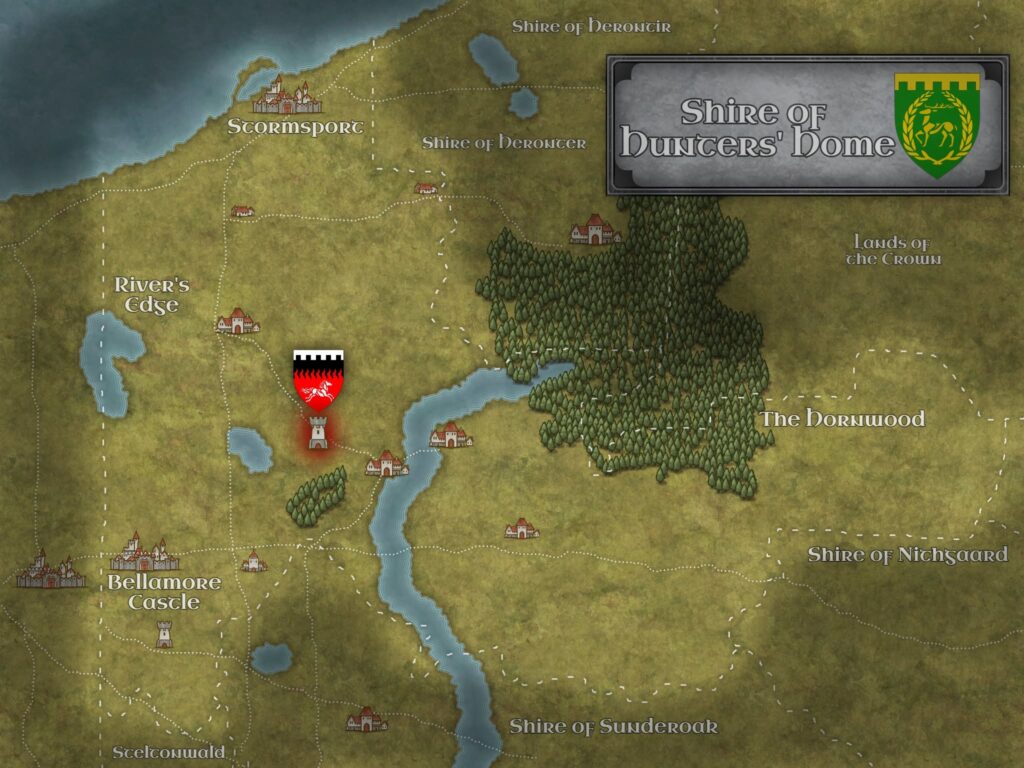
Our Society for Creative Anachronism (SCA) branch geographically covers a large portion of northwestern Pennsylvania. Including Erie, Crawford, Clarion, Forest, Mercer, Lawrence, and Venango counties. The SCA can be hard to describe. It is not a LARP, and it is not a strict historical society, but something in-between. The Society for Creative Anachronism’s Newcomers Portal is a good resource. https://welcome.sca.org/
The Operational By-Laws
The Officers of Hunters Home
The Calendar of Hunters Home Events
The Newsletter of the Shire, The Hunter’s Horn
History of the Shire of Hunters Home
The Citizenry of Hunters Home
Why is the SCA not a LARP?
Historical Research vs. Fantasy Lore
- SCA: Grounded strictly in real-world history prior to 1601 AD. There are no magic systems, monsters, fictional worlds, or non-human species.
- LARP: Frequently features fantasy, sci-fi, or fictional settings with constructed lore, spells, and non-human races.
No Narrative, Quests, or Game Masters
- SCA: Has no storylines, plot writers, Game Masters (GMs), or pre-scripted events. Members create a believable historical identity (a persona) and gather to feast, fight, dance, and display crafts, but they are not acting out a story arc or completing quests.
- LARP: Centered around an evolving narrative managed by plot directors, featuring non-player characters (NPCs), quests, and storyline objectives.
No Character Stats or Leveling Systems
- SCA: Uses no character sheets, stats, health points, or dice. Progress and awards (such as knighthoods or peerages) are earned through real-world craft mastery, physical skill, and service to the community over years of dedication.
- LARP: Uses formal rulebooks where characters earn experience points (XP), level up, unlock class abilities, and manage numerical health or mana pools.
Martial Calibration & Armor
- SCA Combat: Uses unpadded rattan weapons swung with full-force physical impact against real armor (steel, heavy leather, and gambesons). Fights are unscripted and judged entirely on honor: a fighter yields when they receive a blow that would have been lethal through real armor.
- LARP Combat: Typically uses lightweight foam or “boffer” weapons with light-touch hits, safety limits on force, and verbal damage calls. Armor often grants abstract hit-point bonuses rather than serving as structural protection.
Experimental Archaeology vs. Immersive Acting
- SCA: The core focus is experimental archaeology—researching and reproducing historical items using period-accurate techniques (e.g., hand-forging armor, brewing from 14th-century recipes, or weaving textiles).
- LARP: The core focus is theatrical role-play, character acting, and interactive storytelling within a fictional world.
How is the SCA not a historical society?
While the Society for Creative Anachronism (SCA) is legally incorporated as an educational 501(c)(3) non-profit, it is distinct from a traditional historical society (such as the Royal Historical Society or a state/local historical society) because its primary purpose is participatory recreation and experiential learning, rather than academic historiography or archival preservation. The main distinctions include:
- Selective and Idealized Focus: Traditional historical societies document and analyze history in its full, uncensored context, including disease, extreme poverty, and social oppression. The SCA operates on an informal philosophy of recreating pre-17th-century culture “as it ought to have been”—retaining medieval crafts, courtesy, and martial arts while intentionally filtering out period bigotry, bad sanitation, and feudal inequality.
- Blended Chronology (“Creative Anachronism”): Academic historical societies focus on specific, strict time periods and geographic regions. In contrast, the SCA covers any culture from global history prior to 1601 AD. At a single SCA gathering, an 8th-century Norse shieldmaiden, a 14th-century Italian merchant, and a 16th-century Tudor courtier might sit at the same table.
- Experimental Archaeology vs. Archival Preservation: Formal historical societies collect primary document archives, preserve historical sites, and publish peer-reviewed papers. The SCA focuses on hands-on “experimental archaeology”—members research period techniques specifically to recreate them physically by hand-forging armor, sewing historical clothing, or brewing from centuries-old redactions.
- Living Experience vs. Curatorial Study: A traditional historical society’s primary output is public documentation, museum displays, and academic literature. An SCA group’s primary output is immersive events—tournaments, feasts, and workshops—where members actively live out historical skills in a social environment.
BUT There is Role Playing!
Constructed Personas and Feudal Hierarchy: SCA members develop personal historical identities (personas) and operate within a simulated feudal political structure. The kingdom’s leadership (Kings and Queens) is determined by martial skill in armored combat tournaments. Lore and a rich fictional history develops around the very real participants. Most participants were first fans of Tolkien fantasy, Dungeons and Dragons, Fantasy literature and games, so this tends to spill over into our interactions on a regular basis.